


The short answerElectricity under the price cap is 26.32p per kWh (1 October to 31 December 2026). A modern split unit cooling a bedroom typically draws somewhere around 0.3 to 1kW once the room has cooled, so it costs roughly 8p to 26p an hour. A night of 8 hours at 0.5kW is about £1.05. Used for heating, a good unit gives three to five units of heat for each unit of electricity.
Questions about your own home? Olly answers them himself.
Air conditioning running costs come down to three things: how much power the unit draws, how long it runs, and what you pay for electricity. This guide works through the sums for UK homes at the October to December 2026 price cap, for cooling and for heating, and shows how to keep the bill down. The figures are our worked examples using Ofgem’s rates, not a promise for any one home.
How much does air conditioning cost to run per hour?
At the price cap of 26.32p per kWh, every 1kW the unit draws for an hour costs 26.32p. A modern inverter unit doesn’t run flat out all the time. It works hard to bring a room to temperature, then slows right down to hold it. So the hourly cost is highest in the first half hour and much lower after that.
| Average electrical draw | Cost per hour | 8 hours (one night) | 24 hours |
|---|---|---|---|
| 0.3kW | about 8p | about 63p | about £1.90 |
| 0.5kW | about 13p | about £1.05 | about £3.16 |
| 0.75kW | about 20p | about £1.58 | about £4.74 |
| 1kW | about 26p | about £2.11 | about £6.32 |
| 1.5kW | about 39p | about £3.16 | about £9.48 |
Worked at 26.32p per kWh, the Direct Debit average for Great Britain. Your own tariff may be higher or lower.
How much power does an air conditioner use?
Less than the number on the box suggests. A unit sold as “3.5kW” can move about 3.5kW of heat. That is its cooling capacity, not what it takes from the socket. The electricity it uses is roughly the heat it moves divided by its efficiency.
A simple example: a unit holding a bedroom cool might be moving 1.5kW of heat out of the room. At an efficiency of around 5, that takes about 0.3kW of electricity, or about 8p an hour. Pulling a hot loft down on a 32°C afternoon is a different job, and the draw can be several times higher until the room settles.
Your unit’s data sheet lists its rated power input. That is the best guide to the top end of what it can draw.
How to read the energy label
Every new split system carries an energy label with two numbers that matter:
- SEER is the seasonal efficiency for cooling. An A++ unit has a SEER of at least 6.1, and A+++ at least 8.5.
- SCOP is the seasonal efficiency for heating. An A+ unit has a SCOP of at least 4.0, A++ at least 4.6, and A+++ at least 5.1.
The label also gives a yearly kWh figure for cooling. That figure is based on a standard test of 350 hours of cooling at full design load, so treat it as a yardstick for comparing units, not a forecast. Multiply it by your unit rate to get a cost. For example, a label figure of 150kWh comes to about £39 at 26.32p per kWh.
How much does it cost to run air conditioning for heating?
Heating is where air conditioning surprises people. An air-to-air heat pump moves warmth in from outside rather than making it, so it gives out more heat than the electricity it uses. Which? says air-to-air heating costs less to run than other electric heating.
Here is the cost of one kWh of heat at the October to December 2026 cap:
| Heat source | Cost per kWh of heat |
|---|---|
| Plug-in electric heater (1 unit of heat per unit of electricity) | about 26.3p |
| Air conditioning heating, SCOP 3.4 (A rated) | about 7.7p |
| Air conditioning heating, SCOP 4.0 (A+) | about 6.6p |
| Air conditioning heating, SCOP 4.6 (A++) | about 5.7p |
| Air conditioning heating, SCOP 5.1 (A+++) | about 5.2p |
| Gas, before any boiler losses | 7.97p |
Two honest caveats. SCOP is a seasonal lab figure, and efficiency drops in a cold snap. And air conditioning heats rooms, not your hot water, so most homes keep the boiler too. Even so, a well-sized, efficient unit can heat a room for about the same as gas, or less, and for a fraction of a plug-in heater.
Is ducted air conditioning more expensive to run than split units?
It can be. A ducted system pushes air through ductwork to every room, so it has longer air paths and a bigger fan. Heating or cooling rooms nobody is using wastes energy, which is why zoning matters. With Airzone room-by-room control, each room only gets air when it needs it. Separate wall units are naturally zoned, because you switch on only the rooms you use. Our ducted air conditioning page covers the design side.
Why is my air conditioning so expensive to run?
If your bills seem high, these are the usual causes:
- Dirty filters and coils. The unit has to work harder to move the same air. A yearly air conditioning service cleans the coils and checks the system.
- The wrong size. Too small and it runs flat out. Too big and it switches on and off.
- A very low setting. Asking for 18°C on a hot day makes the unit work far harder than 24°C.
- Open windows and doors, or full sun on large windows with no blinds.
- An old, on/off unit. Older non-inverter units run at full power, then stop, then start again. See repair or replace.
- A refrigerant leak. Low gas means poor cooling and long running times. It needs finding and fixing, not just topping up.
How to cut your air conditioning running costs
- Size it properly. We size each room from a heat-gain calculation before we fit.
- Don’t over-cool. A few degrees below the outside temperature feels comfortable. Every extra degree costs more.
- Close windows and doors in the room you’re cooling, and draw blinds on sunny windows.
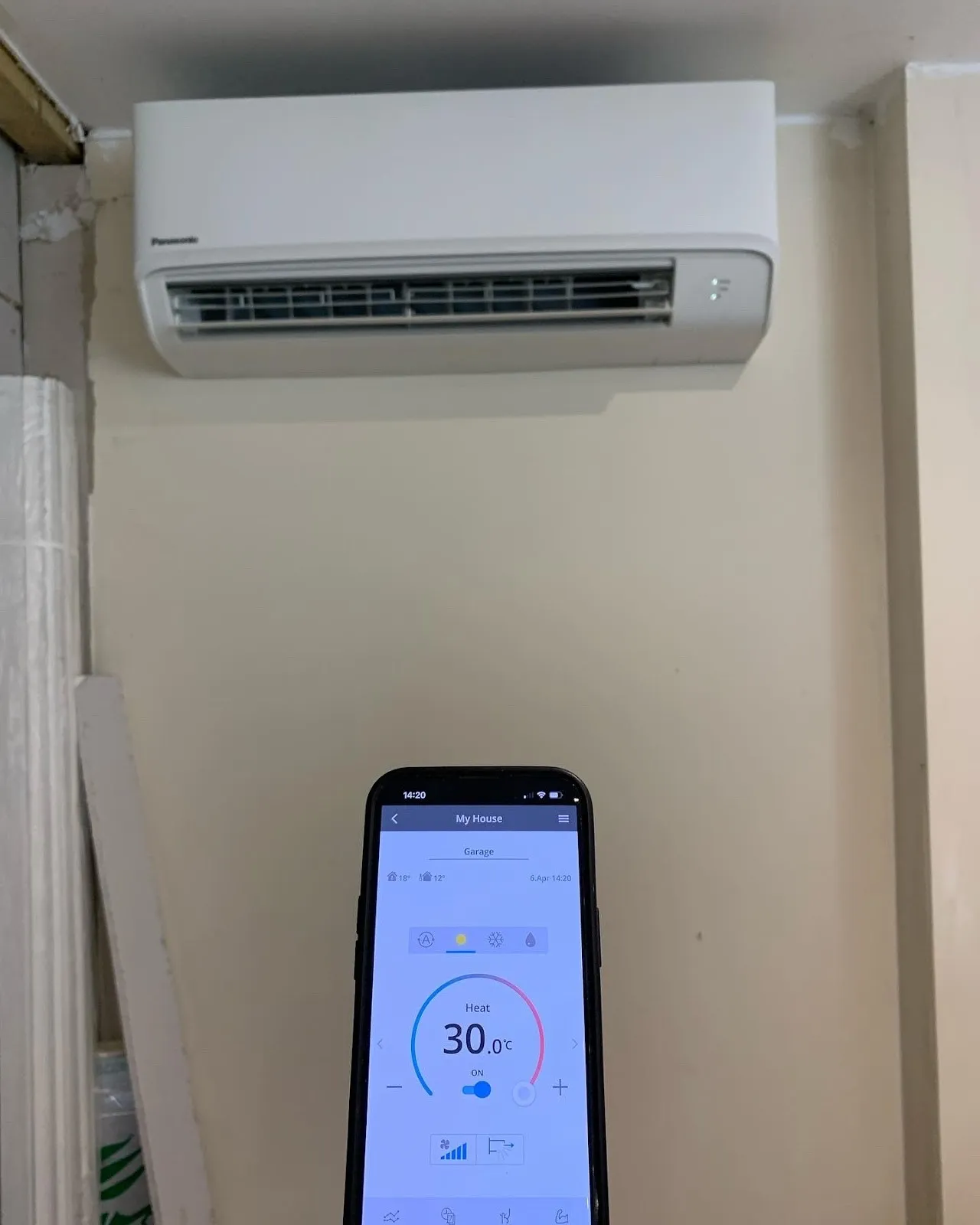
- Use the timer and app so it runs when you need it, not all day in an empty house.
- Clean the filters yourself every few weeks in heavy use. It takes two minutes.
- Keep it serviced. Most warranties need a yearly service anyway, and a clean unit uses less power.
- Choose an efficient unit. On a new system, look at SEER and SCOP, not just the price. Our guide to what air conditioning costs to fit explains what drives the upfront price.
Is it worth it?
For most people, the running cost of cooling a bedroom or office is small, and the heating is cheaper than other electric heat. The bigger decision is usually the upfront cost. Our guide on whether air conditioning is worth it in the UK weighs it all up. Want figures for your own rooms? Ask Olly, or have a look at the wall-mounted units we fit most.
Photos of the rooms and the outside walls get you a first idea, then a free survey.